Built on Cascade · Case study · Published Feb 2026 · Checked 15 Nov 2026
POTS Check
How a shipping iPhone and Apple Watch app was built on Cascade: what it uses, how its records are kept, and what that does and does not show about the protocol.
- Status
- On the App Store since December 2025 (v1.3a)
- Platform
- iOS 18+ and watchOS 11+
- Uses
- The pots vocabulary (now v1.4)
- Stores
- An encrypted local pod on the phone
- Sends
- No health data; optional anonymous usage analytics (privacy policy)
What it checks
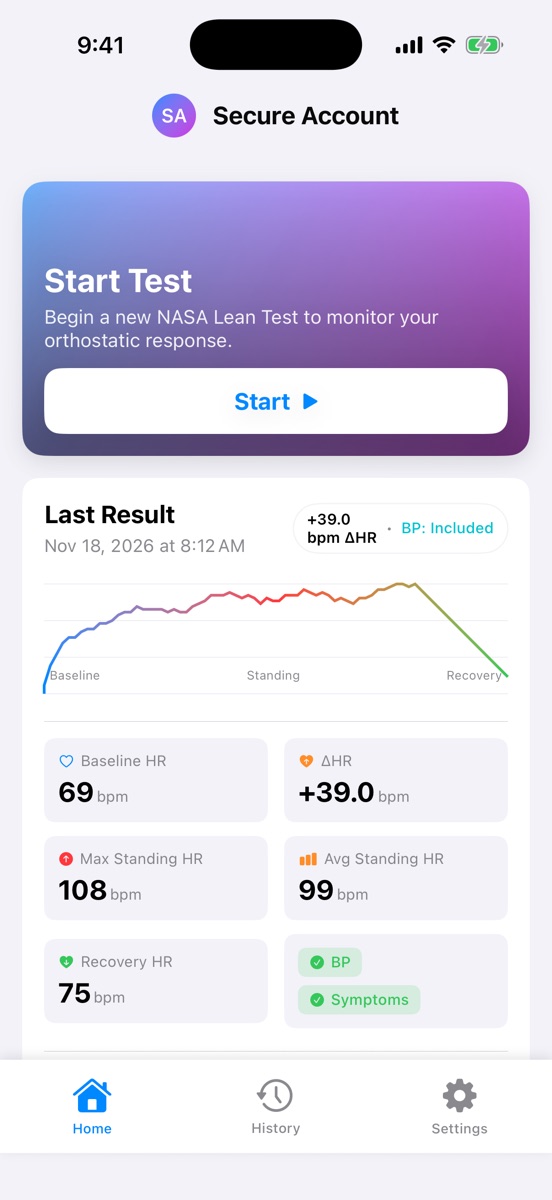
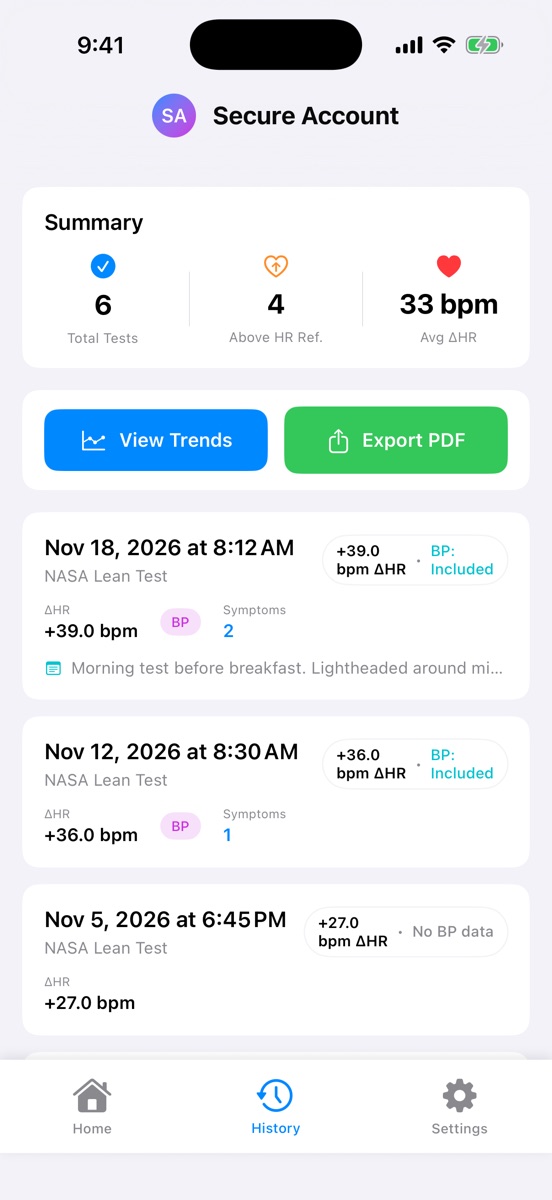
The NASA Lean Test, at home.
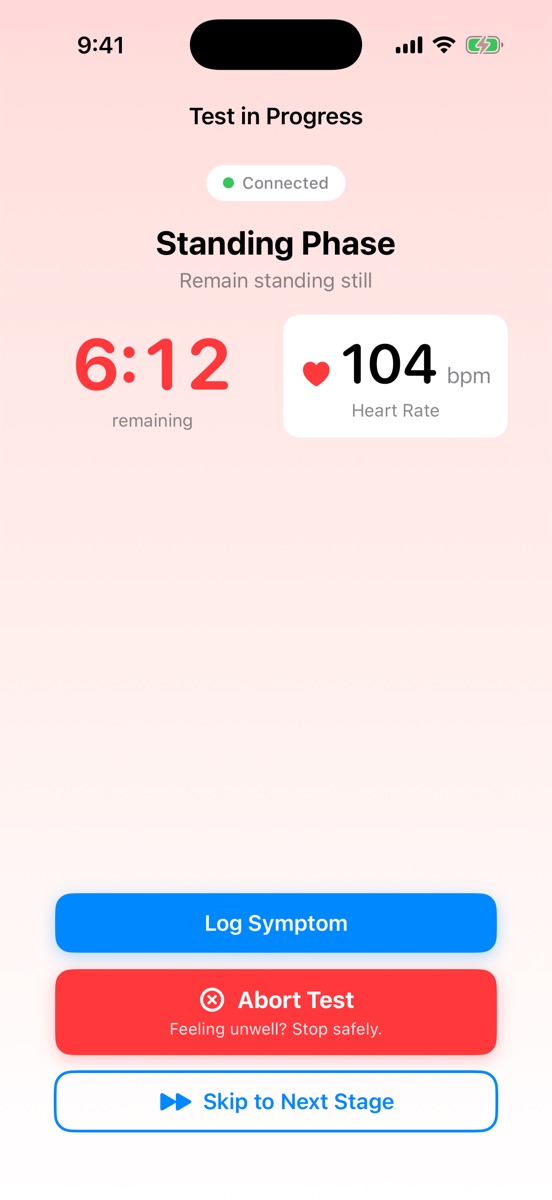
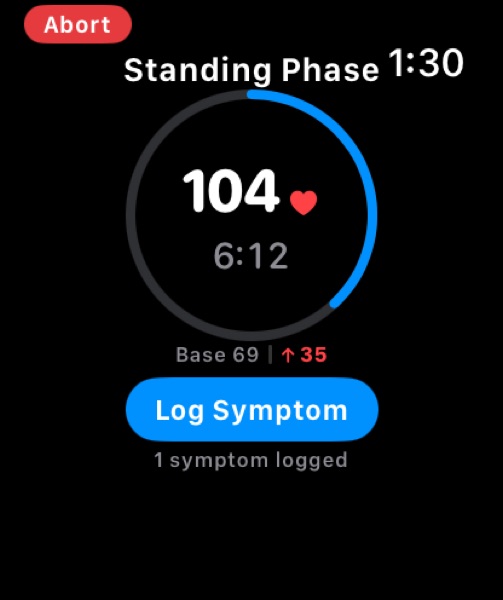
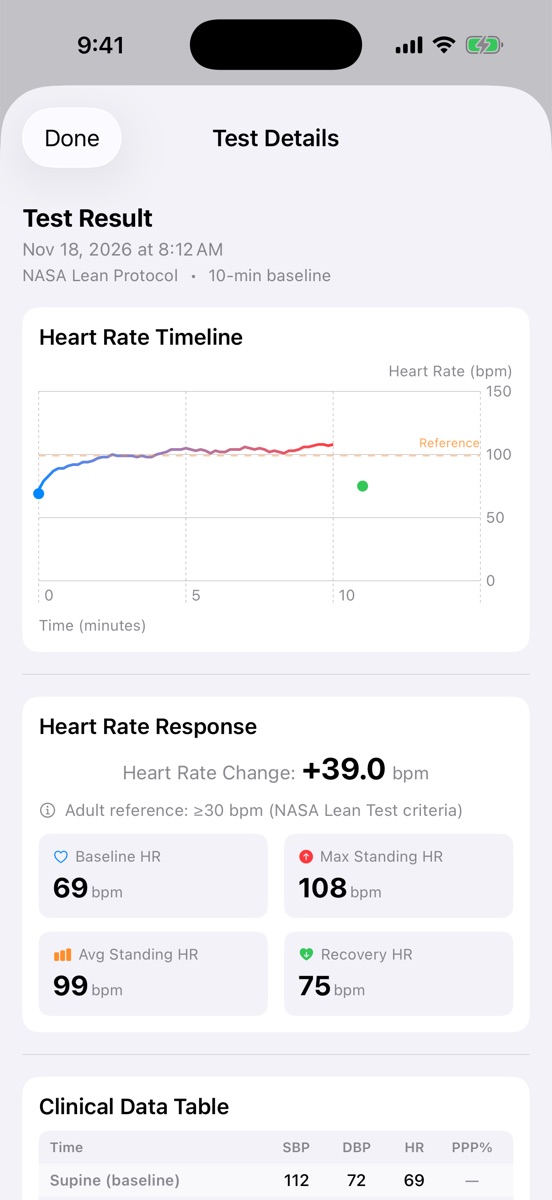
POTS Check runs the NASA Lean Test: a 5-minute lying baseline, then 10 minutes standing, with Apple Watch heart rate and the patient's symptoms recorded throughout. A heart rate rise of 30 bpm or more from baseline (40 bpm or more for ages 13 to 19) meets its screening threshold, which is not a diagnosis; only a clinician can make one.
How it's built
Watch to encrypted file, all on the phone.
| Component | Role | Runs on |
|---|---|---|
| POTS Check iOS app | Test steps, timing, HealthKit access | iPhone |
| POTS Check watchOS app | Live heart rate on the wrist | Apple Watch |
| Apple HealthKit | Heart rate source | iPhone |
| The app's own code | Records, Turtle, pod storage, AES-256-GCM encryption | Inside the app |
| Local pod | Encrypted test sessions as Turtle files | App sandbox |
| Pod export | Encrypted .pod file for a clinician or backup | Made on request |
Which parts of Cascade it uses
| Part | In POTS Check |
|---|---|
| Vocabulary | The pots vocabulary for the result, heart rate and symptoms, with FHIR and SNOMED terms where they fit. |
| Provenance | Follows the app's pots vocabulary v1.4 (the pots vocabulary): a source label on each record, so a sensor reading and a reported symptom stay distinct. The app's source is not public. |
| Pod and encryption | Turtle files in an encrypted local pod, through an early copy of the SDK. The current runtime is not used. |
Data flow
Apple Watch        heart rate samples          DeviceGenerated
   ↓
HealthKit          read per session, heart rate only
   ↓
POTS Check app     + symptoms entered by patient  SelfReported
   ↓
The app's code     pots: records in Turtle
   ↓
AES-256-GCM        key in the iOS Keychain
   ↓
Local pod          wellness/pots-sessions/*.ttl
   ↓  (only if the user exports)
.pod file          shared by Files, AirDrop or email
Nothing leaves the phone until the user exports. No health data is sent to a server.
The protocol in practice
A check result, in Cascade.
An illustrative result, written for this page with terms from pots.ttl v1.4. It is not an export from the app, and the values are made up.
<urn:uuid:e4f5a6b7-c8d9-0123-efab-234567890123>
  a pots:POTSCheckResult ;
  pots:date "2026-01-20T14:00:00Z"^^xsd:dateTime ;
  pots:protocol "nasaLean" ;
  pots:baselineDurationSeconds 300 ;
  pots:uprightDurationSeconds 600 ;
  pots:supineHeartRate [ a pots:HeartRateMeasurement ;
      fhir:valueQuantity [ fhir:value "58.0"^^xsd:double ] ] ;
  pots:standingHeartRates ( [ a pots:HeartRateMeasurement ;
      fhir:valueQuantity [ fhir:value "97.0"^^xsd:double ] ;
      pots:secondsSinceStand "180.0"^^xsd:double ] ) ;
  pots:symptomEvents ( [ a pots:SymptomEvent ;
      pots:symptom "Dizziness" ;
      pots:timestampSeconds "180.0"^^xsd:double ] ) ;
  pots:maxHeartRateDelta "39.0"^^xsd:double ;
  pots:potsThresholdMet true ;
  cascade:dataProvenance cascade:DeviceGenerated ;
  cascade:schemaVersion "1.4" .
Show the vocabulary excerpt from pots.ttl v1.4
pots:POTSCheckResult a owl:Class ;
  rdfs:label "POTS Check Result"@en ;
  rdfs:subClassOf prov:Entity .        # exactly one pots:date, pots:protocol
pots:HeartRateMeasurement a owl:Class ;
  rdfs:subClassOf fhir:Observation .
pots:SymptomEvent a owl:Class ;
  rdfs:comment "User-reported symptom captured during the standing phase"@en .
pots:supineHeartRate a owl:ObjectProperty ;
  rdfs:range pots:HeartRateMeasurement ;
  owl:equivalentProperty sct:78564009 .   # Heart rate at rest
pots:maxHeartRateDelta a owl:DatatypeProperty ;
  rdfs:range xsd:double .                  # 30-second rolling average
pots:potsThresholdMet a owl:DatatypeProperty ;
  rdfs:range xsd:boolean .                 # >=30 bpm adults, >=40 bpm ages 13-19
Full definitions: the pots vocabulary.
Provenance
Each record says where it came from.
One test session holds records from different sources, and each carries its own provenance, so a clinician reading the export can tell a sensor reading from a reported symptom.
- Heart rate
cascade:DeviceGenerated. Measured by Apple Watch through HealthKit. - Symptoms
cascade:SelfReported. Entered by the patient while standing, aspots:SymptomEvent. - The result
cascade:DeviceGenerated. Computed by the app from the sensor data, and holds the readings it was computed from. - Clinician notes
cascade:ClinicalGenerated, if a clinician adds notes to the pod later.
Encryption
Encrypted before it touches the disk.
With an account, every Turtle file is encrypted with AES-256-GCM before it is written. Guest mode keeps data in memory only and writes no files. The key is created on first launch and kept in the iOS Keychain. Exports stay encrypted; the user shares the key separately.
What it shows
What one shipping app shows, on an early copy of the SDK.
The vocabulary is enough
A whole NASA Lean Test check fits the pots vocabulary: result, heart rate and blood pressure, symptoms, posture, flags.
Mixed provenance works
Device readings and patient-reported symptoms sit in one session, each labeled.
Local-first is viable
Encryption, storage and serialization run with no server, offline.
Exports are readable
Once decrypted, the Turtle opens in any text editor or RDF viewer.
The pipeline runs end to end
Apple Watch to HealthKit to the app's early SDK copy to encrypted Turtle, in the released app.
The layers coexist
FHIR and SNOMED mappings, the pots vocabulary and the app's summary, with no change to core.
Scope and limits
A first deployment, not a mature ecosystem.
- One team, one app. Built by the people who designed the protocol; no third-party implementation yet.
- One condition. Says nothing about how well the vocabularies fit oncology, cardiology or genomics.
- No EHR integration. The export is for individuals to share, not institutional exchange.
- An early SDK copy. Its encryption predates the current spec.
- Solid layout only. No sync with a Solid server has been built or tested.